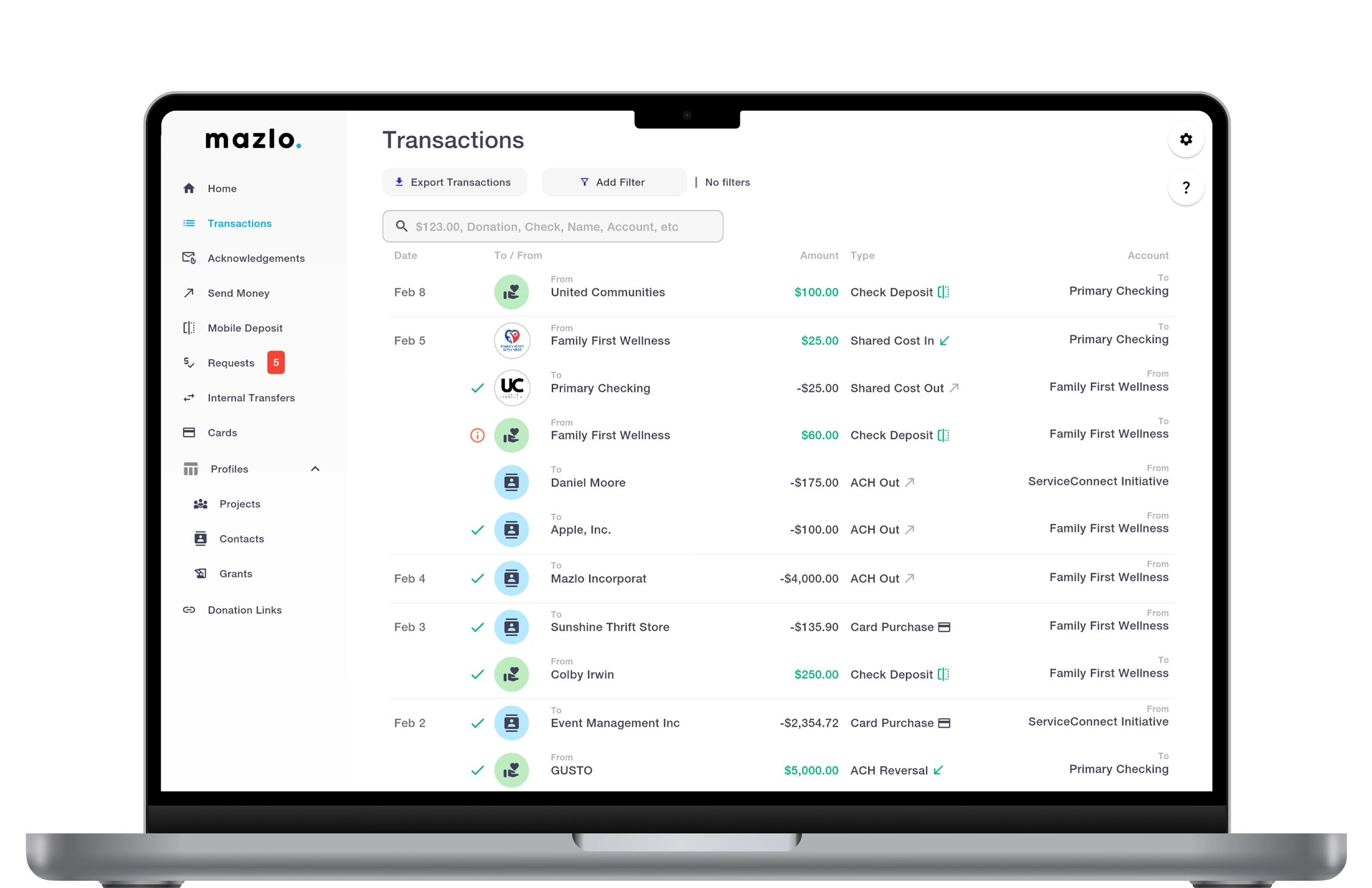
Primary Checking
Primary Checking gives your organization one central account to manage incoming and outgoing funds with confidence. Use it as the operational hub for day-to-day cash flow, core expenses, and top-level oversight across your nonprofit’s financial activity.
Centralized Financial Visibility
Primary Checking gives your organization one clear view of core cash flow and account activity, making it easier to monitor financial health and guide day-to-day decisions.
Stronger Operational Control
By anchoring key transactions in a central account, your team can manage spending with more consistency, improve oversight, and reduce fragmentation across workflows.
Scalable Foundation for Growth
Primary Checking creates a stable base for expansion, so you can add accounts, teams, and programs over time without losing clarity or financial discipline.
Checking Accounts
Checking Accounts help you separate and manage funds by team, project, or purpose while staying under a unified system. This structure makes it easier to control spending, improve visibility, and keep financial operations clean as your organization grows.
Purpose-Built Fund Organization
Checking Accounts let you separate money by program, team, or initiative, so each area has clearer ownership and cleaner financial boundaries.
Better Day-to-Day Spending Management
With dedicated accounts for different operational needs, your team can manage activity more efficiently and make decisions with the right context.
Clearer Oversight Across Operations
Structured Checking Accounts improve visibility across projects and departments, helping leadership monitor performance and maintain stronger financial accountability.
Sub Accounts
Sub Accounts let you break funding into focused buckets for initiatives, events, or restricted use cases without creating operational chaos. You get clearer tracking at the detail level, stronger accountability for budget owners, and better alignment between spending and mission goals.
Granular Fund Tracking
Sub Accounts let you segment dollars at a level that matters, making it easier to track specific projects, events, or restricted funding needs.
Tighter Budget Accountability
With focused account buckets, budget owners can monitor usage more closely and keep spending aligned to approved purposes.
Flexible Structure for Complex Work
Sub Accounts add precision without adding operational chaos, giving your organization a practical way to handle nuanced funding structures as needs evolve.